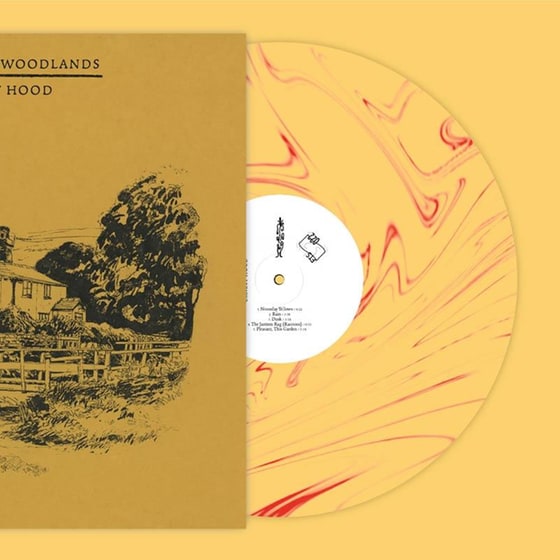
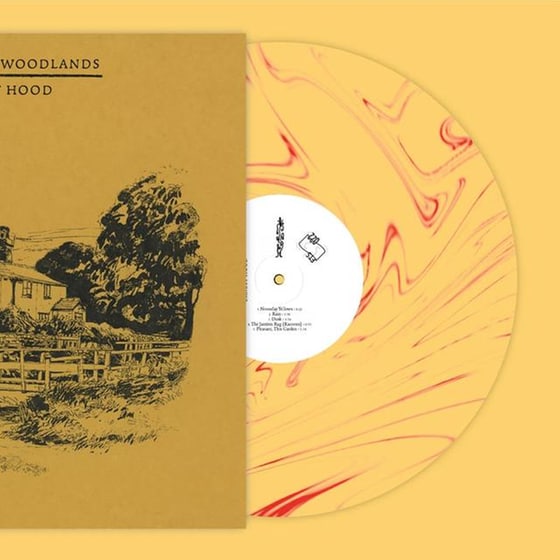
Written and recorded between 1972 and 1982
in Western Oregon, Back to the Woodlands is
a previously unreleased, and nearly lost, album
made by Ernest Hood during the same era as his
near mythical album Neighborhoods. A visionary
combination of field recordings, zithers, and
synthesizers, Back to the Woodlands offers an
unprecedented depth of access to this singular
artistic mind.
Born into a musical family, Ernest Hood began
a promising career as a jazz guitarist during the
1940s, touring internationally with his brother Bill
Hood and the saxophonist Charlie Barnet, before
contracting polio in his late twenties. The disease left
Ernest unable to play the guitar and confined him to
a wheelchair for the rest of his life. It also forced him
to adapt and innovate around his musical practices in
the face of adversity; Hood’s value of sound matured
with a remarkably democratic and nonhierarchical
approach and application.
Taking up the zither, a less physically-demanding
stringed instrument to the guitar, embarking upon
the unprecedented process of incorporating field
recordings into his work as early as 1956, and
eventually discovering the synthesizer, Hood’s music
became imbued with optimism and subtle cultural
critique. This ethos and technique - refined over the
coming decades - would lay the groundwork for a
sprawling body of radio work, mail order recordings
for homebound listeners, and Neighborhoods, selfissued as a small vinyl edition in 1975.
Where Neighborhoods, a nostalgic opus, drawing
from a well of collective memory of the 1950s, is
defined by traces of human activity, Back to the
Woodlands leaves the modern world behind, delving
into Hood’s love for nature. Only recently discovered
in his archives, the album dramatically expands his
concept of “musical cinematography,” imagistically
triggering states of sensory memory from within its
zither and synthesizer melodies, intertwined with field
recordings made during Hood’s extensive travels
throughout Oregon. If Neighborhoods is a retreat into
the gauzy joys of a romanticized past, Back to the
Woodlands is an immersion in the timeless sanctuary
of the natural world.
A fascinating counterpoint to its predecessor,
Back to the Woodlands brings us even closer to
Hood’s belief in the transportive qualities of sound;
that field recordings could serve as a vehicle for
the imagination and liberation, particularly for
those with similar mobile disabilities as his own.
Across the album’s twelve compositions, the
rippling instrumental harmonics - shifting between
abstraction and playful melody - fold so seamlessly
into the birdsong, bubbling brooks, and other
environmental ambiences, that they often give the
impression of having been recording within the
landscapes toward which they whisper.
Falling somewhere between the immersive
calm of healing music and New Age, the creative
field recording practices of sound ecologists
world building for Folkways, and the jazz infected
ambiences during Obscure / Editions EG’s highest
heights, Back to the Woodlands sculpts an singular
proximity of music for its moment; a form of ambient
sonic realism that draws the consciousness toward
its surroundings as much as within.
Working closely with his estate to maintain his
original vision, Freedom to Spend has restored
and remastered this never before released, lost
masterpiece by Ernest Hood from the original tapes.
Ernest Hood’s Back to the Woodlands will be issued
on vinyl, as well as on CD in combination with its
contemporary Where the Woods Begin, with new
liner notes by Michael Klausman. On behalf of
Ernest Hood and Freedom To Spend, a portion of
the proceeds from this release will benefit Oregon
Wild, an organization dedicated to protecting and
restoring Oregon’s wildlands, wildlife, and waters as
an enduring legacy for future generations.