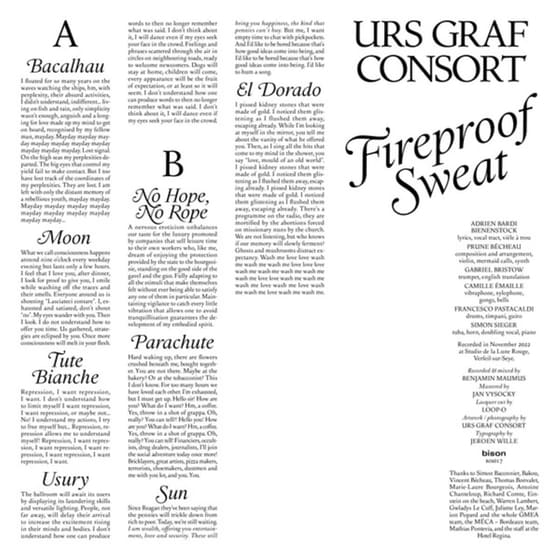
Fireproof Sweat picks up the torch from the group’s second album, Vivéré (2016, La République des Granges), though where Vivéré fights and shouts,
Fireproof Sweat wonders what for.
“Ten years ago, a fire took the lives of four of our friends on rue Myrha in Paris, just a few months after Urs Graf Consort was founded. One of them — Nicolas
Millet, a magnificent bookseller and Félix Fénéon specialist — was meant to be our bassist. The title Fireproof Sweat, and the album as a whole, questions
how surviving the death of friends — outliving collective dynamics that death puts an end to — can carry with it the fear of betraying who we used to be, the
fear of gradually losing our freedom. Vivéré, whose tracks were written both before and after that fire, was about fighting and shouting to stay vibrant with the
will to live that preceded the crime. Fireproof Sweat, written after the mourning had passed, is its cerebral and anguished counterpart — about feeling
uncomfortable with where you end up, and about repentance and regret in the face of everyday life.”
Writing in Italian allowed for a kind of naïve retour aux sources and opened up a more subjective form of songwriting. Percussionist Camille Emaille and
drummer Francesco Pastacaldi each make their first appearance in the group, lending spacious restraint and gorgeous texture, and when paired with the
brass of Gabriel Bristow and Simon Sieger they form an irresistibly light touch quartet. Led by the curious invention of singer Adrien Bardi Bienenstock and
violinist Prune Bécheau (also cited as performing ‘mermaid calls’), musically Fireproof Sweat is the most direct Urs Graf record to date, yet its theme is one of
loss; the bacchanalia of 2020’s Uva Ursi replaced by introspection.