Από 11,65 € /μήνα
σε 6 άτοκες δόσεις, με πιστωτική κάρτα
Περισσότερα
Αναλυτική Περιγραφή
Einstürzende Neubauten present their new
album. RAMPEN (apm: alien pop music)
They search for new forms ‒ pursuing
undiscovered sounds and unspoken words.
Since the band was founded on April 1, 1980,
Einstürzende Neubauten have been shifting the
parameters of mainstream and subculture to make the inaudible audible ‒ perhaps the
unheard as well. This experimental field
research, spanning more than four decades, is
now entering the next stage.
In its 44th year of existence, the band is going
back to its roots while redefining itself. It’s a
change in self-image, for which the Berlin
quintet plus one has created its own genre in
2024: apm – alien pop music.Constant evolution – that’s how Einstürzende
Neubauten’s body of work can best be
summarized. A musical evolution, which began
with the debut album Kollaps in 1981 and is now
being manifested with the release of the album
Rampen – apm: alien pop music in April 24, on
which Blixa Bargeld, N. U. Unruh, Alexander
Hacke, Jochen Arbeit, Rudolph Moser and Felix
Gebhard present themselves from their most
unpredictable and unconventional sides. On
their new album, the Neubauten now put an –
albeit belated – end to all sound speculations.
Since the mid-1980s, Einstürzende Neubauten
have been experimenting on stage with what
they call “ramps”: public improvisations with
open developments and outcomes;
launchpads into the still unexplored that the
band performed in 2022 during the encore on its
last Alles in Allem tour and those recordings
served as the basis for the new album.Rampen – apm: alien pop music is pop music
for parallel universes and in-between worlds ‒
for hyperspaces and interzones. It is
microcosmic and intergalactic at the same
time. It’s a demi-sophisticated claim outside of
all physical laws, with which the Einstürzende
Neubauten enter a stylistic no man’s land
between the past and future. There’s a return to
the roots on one side, while a new art form
emerges on the other from powerful eruptions
of noise encountering cryptic, often
fragmentary lyrics: Popular music for aliens and
outcasts. Anti-pop has become alien pop.
Outlandish. Spun like a cocoon. Unheard.
Sonus inauditus. Not unintentionally, the
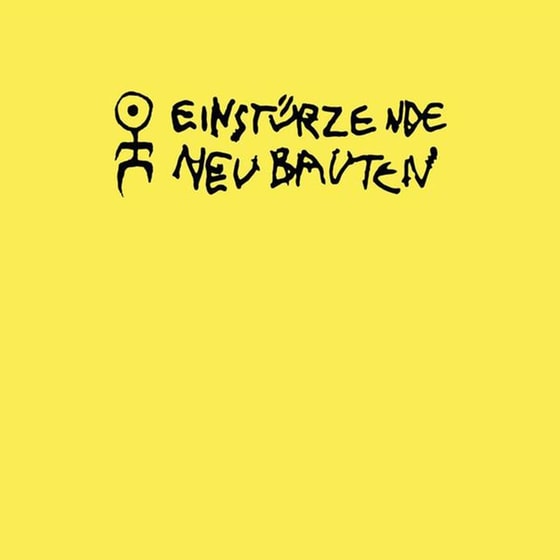
reduced artwork on the cover is reminiscent of
the iconic layout on the Beatles’ White Album.
“It’s based on the idea that the Einstürzende
Neubauten are just as famous in another solar
system as the Beatles are in our world,” Blixa
Bargeld said, remarking on the balancing act
between avant-garde and tongue-in-cheek,
provocation and pop-cultural discontinuity.This approach also directly defines the central
theme running like a common thread through
all the songs: change, utopian mind games and
transience.
“On the album, I found a few solutions and
formulated things in ways I haven’t formulated
them before, because they were never so clear
to me. I’m somebody who believes you can
attain knowledge through music. It’s always
been that way. I follow the conviction I’ll find
something in the music that I didn’t know
before. And sing something that I didn’t know.
Something that turns out to be true. Or, to take
this down a notch, something that at least has
meaning.” This album represents the next step
in the evolution, where the familiar language is
finally left behind, opening further, infinite
possibilities: alien pop music.