


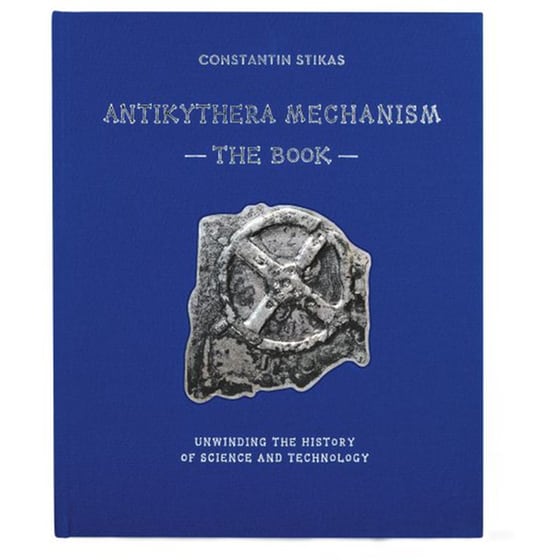


Σύνοψη βιβλίου
"Ο μηχανισμός των Αντικυθήρων" αποκλειστικά στα Public!
Unwinding the History of Science and Technology through exclusive interviews with Mike Edmunds, Michael Wright, Alexander Jones, John Seiradakis, Xenophon Moussas, Theodosis Tassios, Yanis Bitsakis, Efthymios Nicolaidis, Nikolaos Kaltsas, George Kakavas, Agamemnon Tselikas, Eleni Vratsanou, Lefteris Tsavliris, Brendan Foley, Ioannis Theofanidis, Roger Hadland, Tom Malzbender, Girolamo Ramunni, Dominique Fléchon, Philip Poniz, Aurel Bacs, Jean-Claude Biver, Mathias Buttet, Stephen Forsey and Andrew Carol.
The concept of the “Antikythera Mechanism – The Book” was simple.
On the one hand, the book presents the maximum of information and scientific knowledge based on the evidence that research has produced with the help of technological advancements in the last decade, as well as historical evidence – and it all comes straight from the most prominent protagonists of international research regarding the Mechanism.
On the other hand, it presents, for the first time in such a clear and well-documented manner, the connection between the Antikythera Mechanism and the history of horology, as seen by the most eminent historians, engineers and experts in the field of horology, the history of which is now rewritten and establishes the Mechanism as the first known link in a ‘chain’ that extends to our own era, with the manufacturing of the most impressive and complex astronomical timepieces of our time.
All of the book’s scientific and historical knowledge is offered through the answers given by the most distinguished researchers of the field to specific questions in interviews, looking for answers that help us understand what really interests and concerns us all. I think this approach can lead to better results for the intended readership of this book than the standard presentation for academic journals or museum catalogues.
Well, is the Antikythera Mechanism related to the gearbox in cars, to Kepler’s third law? What delayed the spread of technological knowledge already acquired by ancient Greeks, creating a gap of a thousand years in history? And, finally, is this the same knowledge that reaches all the way to modern-day wristwatches and other modern devices and applications? Did the ancient Greeks invent the computer?
In the book’s novel approach, the most profound and sophisticated scientific research conducted by outstanding scientists is presented in an extensive and creative manner, while the material also reaches out to the book’s readers and answers their questions, poses new ones, fills them with strength, pride and inspiration. It even becomes a game, both constructive and instructive – a game played in the classroom or with LEGO bricks.
It is said that the Mechanism brings together everything the ancient Greeks knew about astronomy up to the day the device was built. In a similar way, as luck would have it, Antikythera Mechanism – The Book was being printed –after more than two and a half years of preparation– on the very day that the third –and extremely promising– underwater excavation of the shipwreck site was initiated by the Greek Ephorate of Underwater Antiquities in collaboration with Brendan Foley and his team. The book thus recorded all the knowledge gathered up to that point from the processing of the findings of the first two underwater excavations – the one by Symiot sponge divers in 1900-1901 and the one in 1976 by oceanographer Jacques-Yves Cousteau’s team.
In addition, in tune with what is in my opinion the Antikythera Mechanism’s supreme symbolism, Antikythera Mechanism – The Book is a paean to Innovation.
Stikas Constantin